






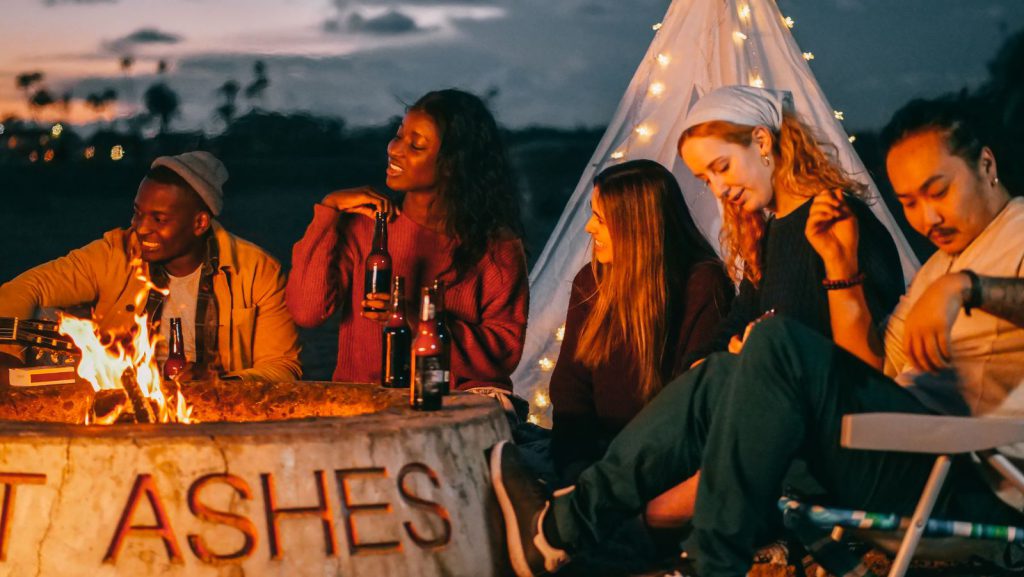
A traditional festival, a wedding you went to, a party you will never forget: festivals and celebrations appear regularly in IELTS Speaking Part 2. They are an easy topic to talk about, because you can describe food, clothes, music and traditions.
Try to explain the meaning behind a tradition, not just what people do, as this shows the examiner more complex language. Below you will find four festival and celebration cue cards with band 7+ sample answers, useful vocabulary, and typical Part 1 and Part 3 questions. For birthdays, see also the birthday cue cards.
You get a cue card and 1 minute to make notes. Then you speak for 1 to 2 minutes. Cover every point on the card, add a short example or story, and finish with the “explain” part.
Festival and celebration cue cards with sample answers
Describe a festival that is important in your country.
You should say:
- what the festival is
- when it is celebrated
- what people do
and explain why it is important.
Sample Answer:
One of the most important festivals in my country is Midsummer, which we celebrate on the evening of the twenty-third of June. It marks the shortest night of the year, when in the north of Europe it hardly gets dark at all.
Most people leave the cities and go to the countryside to celebrate with family and friends. The main tradition is a big bonfire, which people light in the evening and sit around until late at night, eating grilled food, singing and sometimes dancing. Young people jump over the fire for good luck, and there is an old legend that if you find a rare fern flower in the forest that night, you will be lucky in love.
It is important because it is one of the oldest traditions we have, older than Christianity in this region. It also comes after a very long, dark winter, so it is a real celebration of light and summer, and for many people it feels more special than New Year.
Describe a wedding you have been to.
You should say:
- whose wedding it was
- where it took place
- what happened
and explain how you felt about it.
Sample Answer:
The most memorable wedding I have been to was my cousin Laura’s, two summers ago. She married her partner in a small wooden church by a lake, about an hour from the city.
After a short ceremony, all the guests walked down to the lake, where there was a big white tent for the party. We had a long dinner with many speeches, some funny and some very emotional, and then a live band played until about three in the morning. At midnight, according to tradition, the bride’s veil was removed and given to an unmarried woman, which caused a lot of laughter.
I felt very happy for my cousin, because she had waited a long time to find the right person. I also loved how relaxed it was. It was not a very expensive wedding, but everything felt personal, from the hand-made decorations to the songs the band played, and that made it special.
Describe a party you enjoyed.
You should say:
- what kind of party it was
- where it was held
- who was there
and explain why you enjoyed it.
Sample Answer:
A party I really enjoyed was a surprise fortieth birthday party that my sister and I organised for my older brother last spring.
We held it in the back room of a small restaurant he likes. It took us about two months to organise, because we wanted to invite friends from every part of his life, including two school friends who flew in from abroad. His wife told him they were going out for a quiet dinner, and when he opened the door, about forty people shouted “Surprise!”.
I enjoyed it mostly because of his reaction. He is usually a calm person, but he was so shocked that he could not speak for a minute, and then he went round hugging everyone. Later, people told funny stories about him from different times in his life, and there was a lot of laughter. All the planning and secrecy was definitely worth it.
Describe a national holiday in your country.
You should say:
- what the holiday is
- when it is
- how people celebrate it
and explain what it means to you.
Sample Answer:
The national holiday I would like to talk about is Independence Day, which we celebrate in late winter. It commemorates the day, more than a hundred years ago, when my country first declared its independence.
The day starts very early, with the flag being raised at sunrise on a tower in the capital, and a lot of people go to watch even though it is usually freezing. Later there is a military parade, and in the evening the president gives a speech and hosts a reception that is shown on television. Many families watch it together at home, and people comment on what the guests are wearing.
For me it means gratitude. My grandparents grew up at a time when our country was not independent, and they often told me how much they longed for freedom. So on that day I always think about them, and about how lucky my generation is.
Useful vocabulary for festivals and celebrations
Use precise words instead of repeating “party”, “fun” and “nice”:
| Topic | Words and phrases |
|---|---|
| Festivals | a traditional festival, a national holiday, to commemorate, a custom, a ritual, to be celebrated nationwide |
| Weddings | the bride and groom, the ceremony, the reception, a toast, a speech, to tie the knot |
| Parties | to throw a party, a surprise party, a get-together, the guest of honour, to let your hair down |
| Describing atmosphere | festive, lively, joyful, emotional, unforgettable, a buzz of excitement |
| Useful phrases | to go all out, to mark the occasion, to have a whale of a time, to be passed down from generation to generation |
IELTS Speaking Part 1: questions about celebrations
Part 1 questions are short and personal. Give a direct answer and add one reason or example.
1What is your favourite festival?
Probably Midsummer. I love spending the shortest night of the year by a bonfire in the countryside with my friends.
2Do you like going to parties?
I like small parties with people I know. Big parties with loud music are fun once in a while, but they tire me out.
3How do you usually celebrate New Year?
Usually with friends, often at someone’s house. At midnight we go outside to watch the fireworks over the city.
4Have festivals in your country changed since you were a child?
A little. They are more commercial now, with more shopping, but the main traditions, like the food and the bonfires, are still the same.
IELTS Speaking Part 3: questions about festivals and traditions
In Part 3 the examiner asks about festivals and traditions in general. Give longer answers with reasons, examples and both sides of the argument.
1Why are traditional festivals important?
They connect people with their history and with each other. In a fast-changing world, a festival that has been celebrated in the same way for centuries gives people a sense of continuity and identity. They are also one of the few times when whole families and communities come together, which is valuable in itself.
2Have festivals become too commercial?
In some cases, yes. Christmas, for example, now starts in shops in October and is often more about buying presents than about its original meaning. That said, businesses also help keep some traditions alive, and many people still focus on family time rather than spending. It probably depends more on each family than on the festival itself.
3Is it good for countries to celebrate festivals from other cultures?
I think it is mostly positive, as long as it is done with respect. Celebrating Chinese New Year or Diwali in European cities, for example, helps people learn about other cultures and makes immigrant communities feel welcome. The risk is that a festival becomes just a theme for a party, without any understanding of what it means.
Practise on your own
Choose one of the cue cards above, set a timer for 1 minute to make notes, and then record yourself speaking for 2 minutes. Listen back and check whether you covered every point and used some of the vocabulary from this page. For more topics, see IELTS Speaking Part 2 topics and cue cards with answers.