





A beautiful natural place, a park you like, a problem with pollution in your city: the environment is one of the most common themes in IELTS Speaking Part 2, and it often leads to difficult Part 3 questions.
You do not need to be an expert on climate science. The examiner wants a clear description and your personal opinion. Below you will find four environment and nature cue cards with band 7+ sample answers, useful vocabulary, and typical Part 1 and Part 3 questions.
You get a cue card and 1 minute to make notes. Then you speak for 1 to 2 minutes. Cover every point on the card, add a short example or story, and finish with the “explain” part.
Environment and nature cue cards with sample answers
Describe a natural place you have visited.
You should say:
- where it is
- when you went there
- what you did there
and explain why you liked it.
Sample Answer:
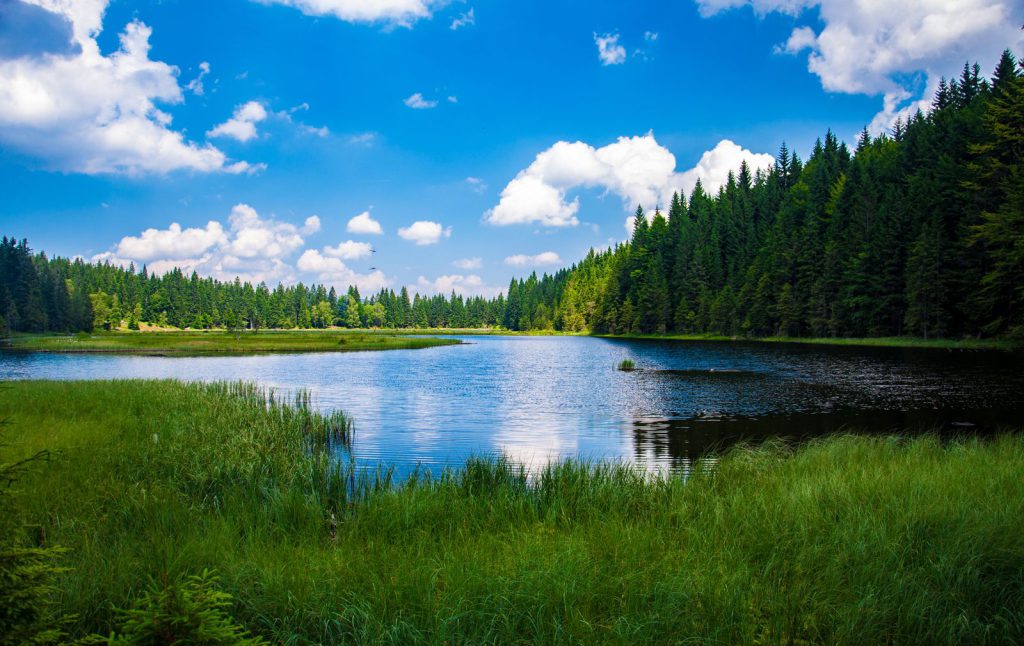
I would like to talk about a small lake in the forest about an hour’s drive from my city. I first went there with two friends three summers ago, after one of them saw some photos of it online.
It is surrounded by tall pine trees, and the water is so clear that you can see the stones on the bottom. We walked around the whole lake, which took about two hours, then had a picnic on a wooden platform by the water and went swimming, even though the water was freezing.
I liked it because it felt completely untouched. There were no shops, no cars and almost no other people, just birds and the sound of the wind in the trees. After a busy week in the city, it was the most relaxing day I could imagine, and we have gone back every summer since.
Describe an environmental problem in your area.
You should say:
- what the problem is
- what causes it
- how it affects people
and explain what could be done to solve it.
Sample Answer:
The biggest environmental problem where I live is air pollution, especially in winter. On cold, still days you can actually see a grey layer of smog over the city centre.
It is caused mainly by traffic, because a lot of people drive older diesel cars, and by houses on the edge of the city that still burn coal or wood for heating. In winter the cold air traps the pollution close to the ground, so it gets much worse.
It affects everyone, but especially children and older people. Doctors say more people have breathing problems, and many parents keep their children indoors on bad days. I think the solution has to come from several directions: better public transport so people leave their cars at home, and financial help for families to replace old stoves with cleaner heating. Some cities near us have done this, and the difference has been really noticeable.
Describe a park or garden you like to visit.
You should say:
- where it is
- what it looks like
- what people do there
and explain why you like going there.
Sample Answer:
A park I really love is the botanical garden near my university. It is only a ten-minute walk from the main building, so I often go there between lectures.
It is not very big, but it is beautifully designed. There is a rose garden, a pond with ducks and water lilies, and a large glass greenhouse full of tropical plants, where it is warm even in the middle of winter. Everything has a small sign with the plant’s name, which I find quite interesting.
Most people go there to relax: students read on the benches, older people walk slowly around the paths, and families bring small children to feed the ducks. I like going there because it is so quiet. When I have an exam coming up, a short walk there helps me clear my head much better than another cup of coffee.
Describe a time when you saw beautiful scenery.
You should say:
- where you were
- what you saw
- who you were with
and explain how you felt at that moment.
Sample Answer:
The most beautiful scenery I have ever seen was in the mountains in the north of Italy, on a hiking trip with my brother about two years ago.
We had been walking uphill since early morning, mostly through clouds, so we could not see much. Then, just before we reached the top, the clouds suddenly cleared, and we could see a whole valley below us: green fields, a tiny village with a church, a river shining in the sun and snow-covered peaks all around.
We both just stopped and stood there in silence for a few minutes. I felt very small, but in a good way, as if all my everyday worries were not that important. I took a lot of photos, but none of them really show how it felt to be there. It is one of those moments I will remember for the rest of my life.
Useful environment vocabulary for IELTS
Try to replace basic words like “nature”, “dirty” and “nice” with more precise vocabulary:
| Topic | Words and phrases |
|---|---|
| Nature and landscape | breathtaking scenery, the countryside, a nature reserve, a mountain range, unspoilt, picturesque |
| Environmental problems | air pollution, smog, climate change, deforestation, plastic waste, to be under threat |
| Causes | exhaust fumes, burning fossil fuels, overpopulation, single-use plastic, intensive farming |
| Solutions | renewable energy, to recycle, to reduce your carbon footprint, public transport, to go green |
| Useful phrases | to get back to nature, to be at one with nature, a breath of fresh air, to do your bit for the environment |
IELTS Speaking Part 1: questions about nature
Part 1 questions are short and personal. Give a direct answer and add one reason or example.
1Do you like spending time in nature?
Yes, very much. I try to go walking in the forest at least once a month, because it helps me relax after a busy week.
2Is there a park near your home?
There is a small one about five minutes away. It is nothing special, but it is a nice place for a short walk in the evening.
3Do you recycle?
I do. We separate plastic, paper and glass at home, and I try to take my own bag when I go shopping.
4Did you spend a lot of time outdoors as a child?
Definitely more than children today. We played outside almost every day after school until it got dark.
IELTS Speaking Part 3: questions about the environment
New to Part 3? See how to give band 7+ answers in Speaking Part 3, with simple and stronger answers compared.
In Part 3 the examiner asks about the environment in general. Give longer answers with reasons, examples and both sides of the argument.
1Who is more responsible for protecting the environment, governments or individuals?
I think both have a role, but governments have much more power. One person recycling makes a small difference, while a law on car emissions or plastic packaging affects millions of people at once. Still, individuals matter too, because governments usually act when enough people show that they care.
2Why do many people still not recycle?
Partly because it is not always convenient. If recycling bins are far away or the rules are confusing, people simply put everything in one bin. Some people also feel that their own effort is too small to matter. Making recycling easier and explaining what happens to the waste would probably help.
3Will people care more about the environment in the future?
I believe so, mainly because young people are much more aware of these issues than older generations. They learn about climate change at school and see its effects in the news. However, caring is not the same as changing habits, so it will also depend on whether green choices become cheaper and easier.
Practise on your own
Choose one of the cue cards above, set a timer for 1 minute to make notes, and then record yourself speaking for 2 minutes. Listen back and check whether you covered every point and used some of the vocabulary from this page. For more topics, see IELTS Speaking Part 2 topics and cue cards with answers.